
Fifty years ago, Studs Terkel’s book Working described work as “a search for daily meaning as well as daily bread.” Since then, work has changed—and I’m trying to write an update. I’m interviewing people about what they do all day and how they feel about it. If you’d like to talk about your work (anonymous or not), please DM me!
I first met Lee at the New York premiere of Time and Water, the National Geographic documentary based on the book by Andri Snær Magnason. We were at the American Museum of Natural History.
She introduced herself as a retired teacher. Only when I asked how long she’d been teaching did I learn about her long career. She was graceful and elegant, but when she talked about science, her accomplishments, her students, and the celebrities she’d met, she became so excited. She is a scientist, but also practical, a hustler. She has had an astonishing number of alternative plans throughout her life.
Here's what Lee Magadini told me:
I think of myself as a scientist who took a beautiful multi-decades detour into Broadway lighting.
I grew up in the deserts of Phoenix, Arizona, surrounded by horned toads, lizards, spiders, and scorpions—there’s wonderful nature there if you know how to look. Yet all my elementary school science books were set in Northeastern forests, full of turtles and frogs I longed to see in the wild.
My love for science was foreign to both my parents. My dad was a structural engineer. My mother was an oil painter. She was always in her studio painting. Yet, she wanted me to be an entertainer, which I was not cut out for. I wasn’t seeking out friends or an audience. I was collecting bugs and doing science experiments in my room.
My science experiments stayed in my bedroom. I went off to college for theater. There, I had a professor who had studied with Uta Hagen, one of the most revered acting professors in the world. The way she worked us made me realize in black and white that this was not my bag.
I was not cut out to be an actor. I wasn’t terrible. But that was about it. The other thing was the uncertainty. I didn’t know where my paycheck was going to come from. I wanted stability and resources. That lifestyle just didn’t make me feel comfortable. Plus, all these coaches kept saying, It’s really horrible being an actress in New York. You get rejected billions of times; they had plenty of dark stories.
So I looked for the light. No, like, literally. I was fascinated by theatre lighting because of its physics. So I shifted my focus to lighting. Lighting fits my business mind. It fits my curiosity about science.
The entire profession of theatrical lighting on Broadway was started by a woman. Jean Rosenthal. She had been Martha Graham’s lighting designer. By the time I was in lighting, there were many accomplished women in Broadway lighting.
A tiny theater in Seattle hired me out of school, and I worked as their lighting designer for about 9 months. And then I worked for a major lighting manufacturer as the sales manager on the West Coast. I was twenty-three years old, running twelve states.
This was the late seventies, early eighties. Alaska was going through the roof with new oil money. They were building theaters in towns of two hundred people. Universities and performing arts centers were going up everywhere. This wasn’t unique to Alaska. There are two things this country does better than anybody: weapons and entertainment. Nobody beats us at either. So there was always room for bigger stages and productions.
In that job, I’d comb through construction reports, track down the architects and engineers, and call on them. Most knew nothing about theater lighting and were happy to have me write the specs they’d drop straight into the bid packet. Many were bored at their desks, so I’d show up with stories and bring bagels. I was the traveling saleswoman, always coming with something. Sales isn’t just about the equipment. It’s about people.
One of our competitors approached me for their Manhattan office. In 1985, I moved from Seattle to the Big Apple, and boy, was I scared! I’d been in Manhattan for less than a month, just settling into a sublet on the Upper West Side, when a big-name client called my home phone (pagers hadn’t come out yet) on a Saturday. He had an urgent problem that needed to be fixed immediately.
That never happened in Seattle. In Seattle, everyone had a job, but you didn’t talk about that. What you talked about was what you did on the weekends, the camping trips you went on, where you went canoeing, or a cool restaurant you found. It was all about the time off. My clients there didn’t even have my home phone.
Then I hit Manhattan. Everyone here was about work. All of it was twenty-four-seven. I changed my game plan. If it meant getting on a train and showing up at the theater on a Saturday afternoon, I had to do that.
I didn’t have an office; I was always on a train, a corporate bee going from office to office. New York’s scale intimidated me, so all I could do was put on my business clothes, walk out the door, and see how the day unfolded. I kept the same instinct from Seattle: always bring something—food, stories, especially gossip about what other designers were doing. It was fun to socialize since everyone in the entertainment lighting world knew each other.
The way I increased my salary was to pay attention to higher-paying jobs in the industry. Because I was based in New York, I had a great location and reputation of knowing people. Everybody wanted me to work for them.
One of my last career switches was to Vari‑Lite, a rock‑and‑roll lighting company that invented moving lights which could change color with motors. The band Genesis backed the idea. After seeing the prototype, Phil Collins put a quarter of a million dollars—a huge sum in 1980—in the business and said ‘That’s our special-effects budget. We’re in.’
By the time I joined Vari-Lite, there wasn’t a rock-and-roll show without a large Vari-Lite lighting system and personnel on the tour. Genesis, The Rolling Stones, Elton John. Michael Jackson.
In 1992, I started at Vari-Lite; as a sales associate; then, after 6 months, I was promoted to manage the New York office. Vari-Lite New York became one of the most successful branch offices in the company. We worked on Ragtime, Wicked, Lion King and many others.
I had a showroom in our office on the 16th floor of what is now Google’s office in Chelsea. Instead of being a corporate bee on trains all day, the designers came to me. One night a lighting designer called and said, “Lee, I have a very important collaborator. Can we come after hours tonight? We want to play with this brand-new fixture, the VL7.” The collaborator turned out to be Mikhail Baryshnikov. That night, the designer, Baryshnikov, and choreographer David Parsons were in my demo room, conceptualizing a piece right in front of me. I watched this magnificent dance, a private performance in my showroom.
Lighting and dance are partnered. When Jean Rosenthal lit Martha Graham, she referred to herself as an electrician. Martha corrected her, saying, “You’re an artist. You don’t understand—you’re an artist.” If you ever see stills of Martha Graham on stage, they’re magnificent. That’s Jean Rosenthal’s lighting.
It was a full career. Top of the world. Top of my game. I’d get invited to a lot of opening nights. I didn’t have kids. I didn’t have a partner. I was free. If I got a last-minute invite to a show, I was down. I would dress up for many of those. Sometimes it was a black-tie event. I rubbed shoulders with many famous and talented people. When my parents came out to visit, I’d look for our Vari-Lite shows and . call the general manager to say I need three house seats. That was it. Hah! I miss those days. That’s when my mother finally reconciled that I was never going to be an actress. She saw me as a business person for the first time.
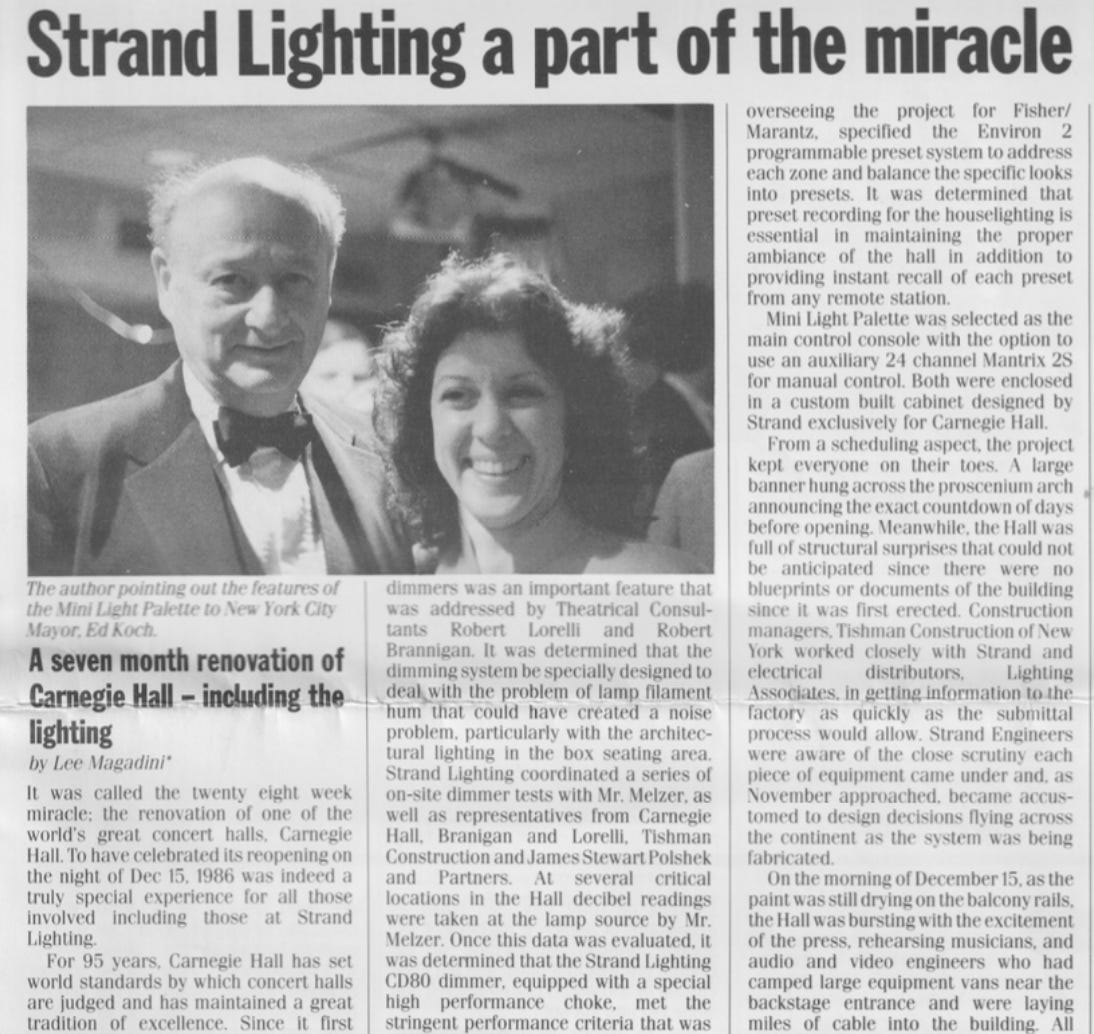
Everything was going great—until the company went public. Suddenly it was endless paperwork and reports. Can you believe that I had to miss the Bee Gees at Madison Square Garden because of a report?
Then Vari-Lite decided to expand into basic gear—fixed-focus lights, cable, dimmers, all the inventory-heavy essentials. I kept warning the executives, “You don’t want to go there—it’s a nightmare of inventory.” Eventually, I told the CEO, “It’s been great, but I have to move on.”
I took another job. It wasn’t glamorous, but I was tired and in my mid-forties. The work was so easy I had free evenings again, so I started studying shiatsu.
Then my dad had a stroke. My mom had already passed. I knew I had to go care for him.
At that point, I was giving up the lighting industry. I knew it. It moved too fast. I didn’t know how long I’d be gone. But I knew the technology would change. The people would change. Everything would change. And I’d already done that climb once, so I wasn’t sad about that.
Living with my father was a gift. We got to know each other. His stroke was minor. The only thing he couldn’t do was drive. So I drove him everywhere; to dances, to his friends’ parties, to Rotary. He was a very social 90-year-old, and I felt like a soccer mom!.
In Arizona, I figured, what the hell, let me cut my teeth in real estate. I got my realtor’s license. I brought my dad to the classes with me. I passed the exam and realized I didn’t like being a realtor. But the Great Recession had just hit and the auctions in Phoenix were unbelievable and I bought quite a few houses. One of them was only $9,000.
One day, out of the blue—this is where science came back into my life—I decided to take biology classes at Phoenix College. On their website, a full-page image of the Great Barrier Reef appeared, showing a trip they took marine biology students on. I tingled looking at it. I already knew the magic of the ocean from learning to dive, so I enrolled!
I went back to school and was going every day. The other students were in their twenties, and I was in my fifties, but I felt young. Wonder dissolves age. Nobody is old in front of something they’ve never seen before.
I discovered that there is more theater inside of a cell than you can possibly put on a stage. It is magical. The operations of a single cell are phenomenal. And then the layers you discover later. Like the mitochondria. It has its own DNA, which traces back through the matriarchal lineage all the way back to Eve. You can trace anyone through their mitochondrial DNA. I had many big wow moments such as this as I was learning.
My father passed away in 2010; I settled his affairs. I moved back to Hoboken the same year. I couldn’t have stayed any longer in Phoenix. I was going to dry up there.
Unsure of what I was going to do, a friend from Vari-Lite suggested I interview for an executive position at her company. On the morning of the interview, I saw an ad in the newspaper for a fully funded New York State master’s program at NYU for future biology and chemistry teachers. I knew I wasn’t done with science, and science wasn’t done with me. I blew off the job interview and applied for the master’s program instead. I got in.
We were sixteen in the class. One guy was sixty, another was fifty. The rest were all in their twenties. But we all got along. We all wanted to be teachers and at NYU, I was alive with excitement. I was commuting from New Jersey every day!
The state was paying because it needed science teachers in high-needs schools. So the deal was, the day we graduated, we had to start applying to schools. I applied to many schools and went to many interviews. I was rejected by all. I suspected some of the young principals found a strong woman in her mid-fifties intimidating.
After a year of interviews without a single job offer, I realized I needed to create my own opportunity. There was a science teacher I’d observed during my NYU program; Roy At the Harbor School on Governors Island, NY. He was so good. Not warm and fuzzy, but a twenty-year veteran who was brilliant at teaching science to classrooms of rowdy high school students.
I called him up. Roy, I said. You won’t remember me, but I was part of the NYU class that came to observe you. I have a deal that I want you to consider. I would like to come and be your assistant. And you would have me at no charge. I will grade papers and assist in the class. I want to observe you teach. We can do it for six months. Are you open to that? Would the principal be open to that?”
So it was, yes. I would get on a ferry every morning to Governors Island and try my best to teach these wild kids. It was challenging, fun, and rewarding.
One day, I was grading papers at Roy’s office, and a guy showed up. Roy said, Lee, I want to introduce you to Bob N.. He’s a scientist at Lamont-Doherty Earth Observatory, upstate. Bob was on the island for the Billion Oyster Project. He was there to present at a big symposium that day. I asked if I could come watch. He said sure.
Bob told me about a summer program they run at Lamont; The Secondary School Field Research Program (SSFRP). About fifty high school students from across New York City commute to Lamont to work on real research in the labs and in the field. I was tingling once again. I didn’t know how it would happen, but I knew I was destined to be part of this. I have always loved the Lamont campus. It’s the most magnificent place. I used to sneak into any seminars they offered to resident and visiting scientists. When security asked for my credentials, I’d say I was with Scripps. All I had was a Scripps Aquarium membership, but security assumed Scripps Institute of Oceanography - ha, I was in!
So I asked Bob right then. Do you have teachers? Do you need one? I’d like to apply. He said, you don’t have to apply, you’re in. It’s the best job interview I’ve ever had. I started that summer. I was really scared at first. Bob asked me to come up with a project or study that had to last six weeks. I eventually came up with a study looking at the stomach contents of Hudson River fish. It didn’t harm them. Nobody at Lamont had really been studying microplastics in organisms before. What I was exploring with my team of high school students was new ground at Lamont.
The summer program was created in the early 2000s by Susan, a high school teacher to help struggling students find a foothold in science. Each year, about fifty New York City teens received privately funded stipends, and admission didn’t depend on grades—so some participants were on the verge of dropping out.
The transformation in these kids is phenomenal. Phenomenal. More than a thousand kids have come through SSFRP. When they realize the work they’re engaged in is real, the transformation begins. Every single one, regardless of past grades, has graduated from high school. Every single one who applied to college got in. Half of them went into science. So this was life-altering for these kids. And for me too. I got to work in labs that I would never have been given access to before. And I did that with my army of high schoolers by my side.
Columbia University’s press dept. got word about the program and sent a reporter to write an article about us. Our microplastics team ended up in an article in Columbia University’s journal. Then, to my astonishment, I got a call from National Geographic. They wanted to write about our work analyzing microplastics in shrimp. This was one of the most magical moments of my life. It’s very rare for this to happen to a high school teacher (and students!)
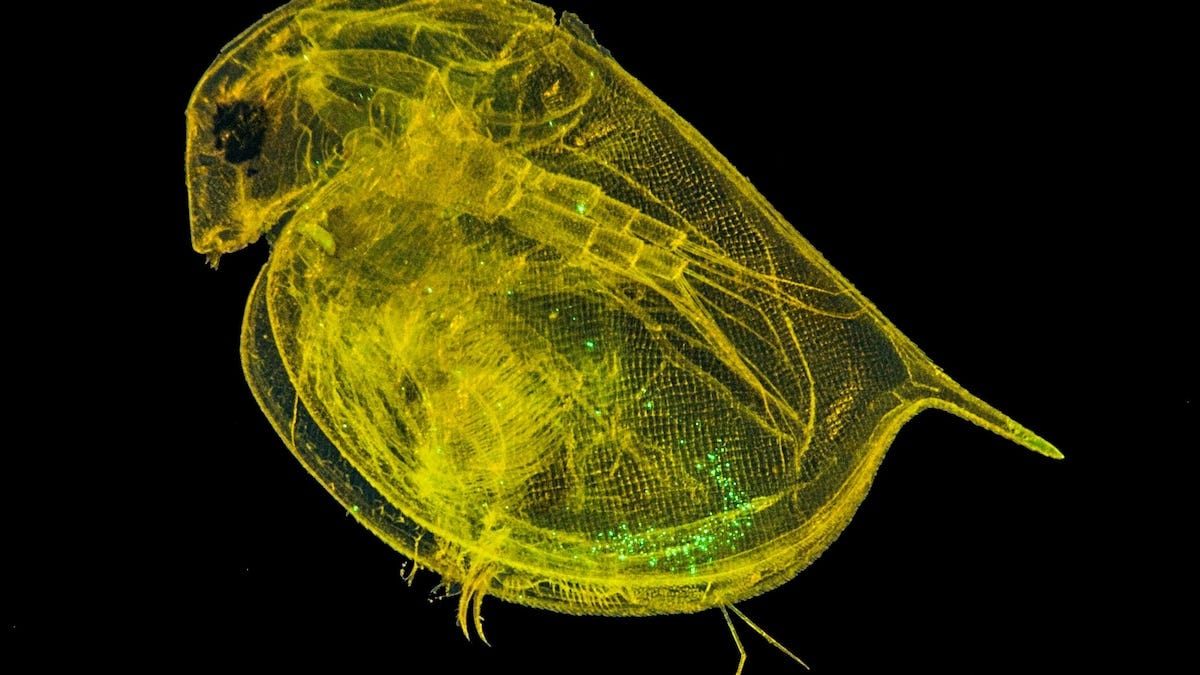
After that, I continued pursuing research. With the help of our mentor scientists, I even had a paper published! After three years of research, a year to write it, and 3 sessions of peer review, it was finally published in “Science of the Environment” and has since been cited over 100 times.
The Lamont work was in the summer. For the rest of the year, I was hired by a small Waldorf high school in Massachusetts. It was an ideal arrangement and I was able to build their science department from scratch.
During my job interview, the school’s director asked about my teaching philosophy. I told him this story: When I was a student teacher at NYU, I was placed on the Lower East Side in a high-needs title 1 school. It was a tough group of kids. Some didn’t have parents. Some were already in gangs. There was one kid who was always struggling Richie. One day, I was teaching the class about climate change. He raised his hand. I said, yes, Richie? You’re actually raising your hand. He said, ‘Miss, are we all gonna die’?
Oh my god. I went home that night and thought about it. I’m scaring the crap out of them. These kids have never even had a chance, in their young lives, to wonder about nature. Why would they want to protect it? They’ve never seen a fish. They’ve never held a frog. If you can’t cultivate wonder, people become cynical. So that’s my teaching philosophy; to cultivate wonder.
After I finished this story, the director said, “You’re hired”.
Science was mandatory for all high school students, so I taught a mix of kids—some excited about science, others not. There were very few I couldn’t get jazzed about science in some form. I taught freshmen through seniors and had freedom over the curriculum, but everything built toward evolution by their senior year. From freshman year on, we worked through cell biology, botany, physiology, and anatomy. We took field trips, camp-outs, and field studies, and the kids were always collecting data. I insisted on that; I wanted them to understand data and that it revealed a story. I was paid almost nothing, but working with these students was worth it—and fun.
Teaching teenagers, I learned, is like riding a horse. As an equestrian, I know you are never quite sure what a horse will do, so you have to relax, listen, and respond. You cannot arrive with a rigid agenda and try to control the students. Generally speaking, you never knew what would crop up. A student once threw a chair across the room. Another time, after a school play rehearsal kept them up until 11:00 PM, my class was too exhausted for biology. With 20 minutes left, I said, ‘Everyone just go to sleep—on the floor, anywhere.’ They all did.”
I retired in 2019 from the Waldorf school and in 2022 from SSFRP at Lamont. I felt I had reached the pinnacle. I wanted to give these opportunities to younger teachers. And then Covid hit, and I thought: oh, thank God I’m not teaching! Trying to teach science in a Zoom classroom is practically impossible.
Honestly, so many opportunities fell into my lap after my father died that it felt like my parents were helping from above. I can just see my mother in heaven, slapping her halo and exclaiming, “Oh my God, she was a scientist all along!”
How is retirement treating me, hmm? I traveled with a friend to Mexico City. That was fun. I manage some of the properties I bought in the financial crisis. That is not fun, especially after flooding in Hoboken destroyed my ground floor and took two years to repair. I’m now renovating a house in Phoenix, where I recently adopted an abandoned cat, who is now my constant companion.
A lot of the time, Mona, I’m glad I’m retired. In this AI world, everything is changing so fast I can’t keep up; I barely know the names involved. I’ve reconnected with the woman I used to practice shiatsu with and want to return to that work—I think it will calm me. I also want to read more spiritual, philosophical writers like Pema Chödrön.
Your observation is very astute: I’ve been a hustler my whole life—through theater lighting, real estate, science, and teaching. Even as a kid, I ran a little store in my bedroom, selling things to my family (chocolate-covered cherries were a hit). Now I’m finally not hustling. When I wake up, I don’t have to do anything, so I spend my days exactly how I want—like having this meeting with you now.1
Now, if you will excuse me. I need to go get some dumplings in Chinatown for my sick friend. He just got back from the hospital. If you’re looking for more people to interview, you should talk to Philip Hirsch. He’s a former colleague. He’s been the Head Electrician at Jazz at Lincoln Center for over twenty years. We could go together. He’d give you a tour. We could all get dinner. Would you like that?
(Mona: Yes, of course I would love that!)
Since this interview, Lee spoke to me about the Trump administration, which is erasing databases from NOAA, the EPA, and other environmental agencies. Over 3,000 data sets have been removed, particularly in climate change research. This is dangerous. Lee is open to new opportunities and quests, especially related to this topic. In her words: I have lobbied in D.C. once before, as a citizen lobbyist, to protect the habitat of the endangered spotted owl. It was a worthwhile experience I can draw on for lobbying senators and Congress once again. We all need to protect the planet in any way we can, for future generations. I feel a calling once again.”
This was a lovely piece. I struggled to get into Terkel's Work but this practically read itself. Thank you! Was this compiled from many conversations or just one?
I'll look forward to the future installment!
> At that point, I was giving up the lighting industry. I knew it. It moved too fast. I didn’t know how long I’d be gone. But I knew the technology would change. The people would change. Everything would change.
[...]
> Wonder dissolves age. Nobody is old in front of something they’ve never seen before.
Career changes are strange like this - the realization that you may have niched down onto the frontier of whatever vehicle is encouraging forward change, then realizing that it requires an enormous amount of emotional and constitutional energy to stay there.
It's no surprise that in the modern age we are seeing such an increase in burnout or sabbatical remove in the workforce; we have developed so many new frontiers that anyone who stays at the front of them often runs out of the energy to keep going. The moment that you stop moving with that momentum, it can feel as though you are being left behind.
What I truly love about this interview is the fact that you've tapped into the sense of fulfillment she has found in not keeping pace, but rather seeking out how the threads of a previous life might fit into whatever personal frontiers can be made instead. It makes, I think, for a far more fulfilling life, which it does seem Lee has felt she has had.
Gibran once wrote, to the great discredit of those who called him a pop philosopher:
> You have been told also that life is darkness, and in your weariness you echo what was said by the weary.
And I say that life is indeed darkness save when there is urge,
And all urge is blind save when there is knowledge,
And all knowledge is vain save when there is work,
And all work is empty save when there is love;
And when you work with love you bind yourself to yourself, and to one another, and to God.