
This is the second essay in my “500 words for 5 days” series. It was much harder to write than I expected. I assumed I had all the thoughts clear in my head and would just type them out, but I was wrong. I apologize if it’s not entirely clear. I’ll come back to edit it later. Feedback welcome.
+++
In early April, everyone celebrated the first one-person billion-dollar company, Medvi. Sam Altman wanted to meet the founder. It’s very impressive, and I applaud that founder. But I don’t like that the story was so quickly adopted by AI CEOs and pitched as the pinnacle of what people can do now that AI is coming after white-collar jobs. The solo unicorn is not an observation about the economy. It is the closest thing the AI industry has to an answer when someone asks what ordinary people will do after AI comes for their jobs.
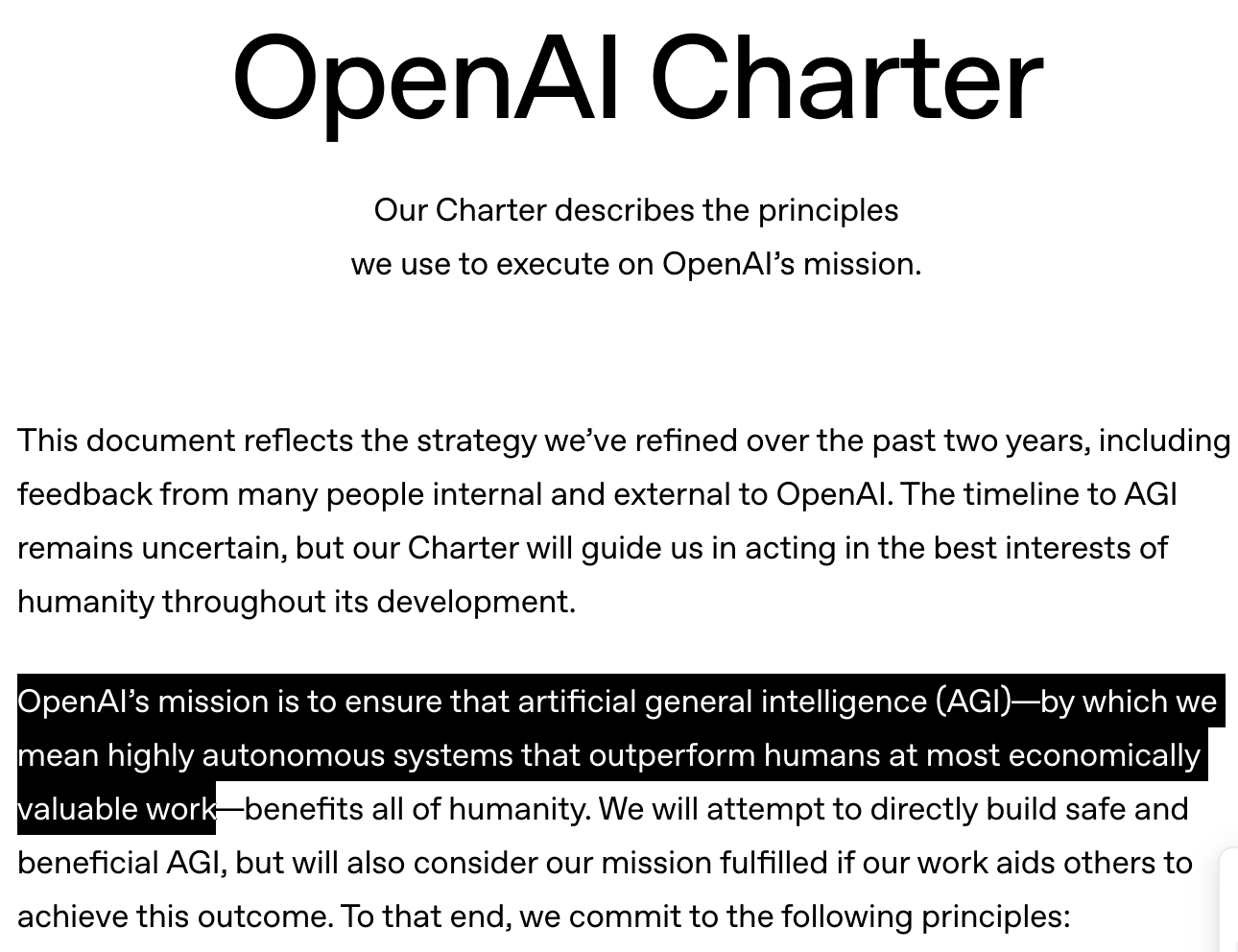
And it is not a serious answer. This vision works for a few, but it cannot be a major alternative to employment, which is what the AI companies propose it as. If you are an accountant fired from an accounting firm, you will now be competing alone against the big accounting firms and against the AI companies themselves, which are coming for accounting too (see the OpenAI Charter below).
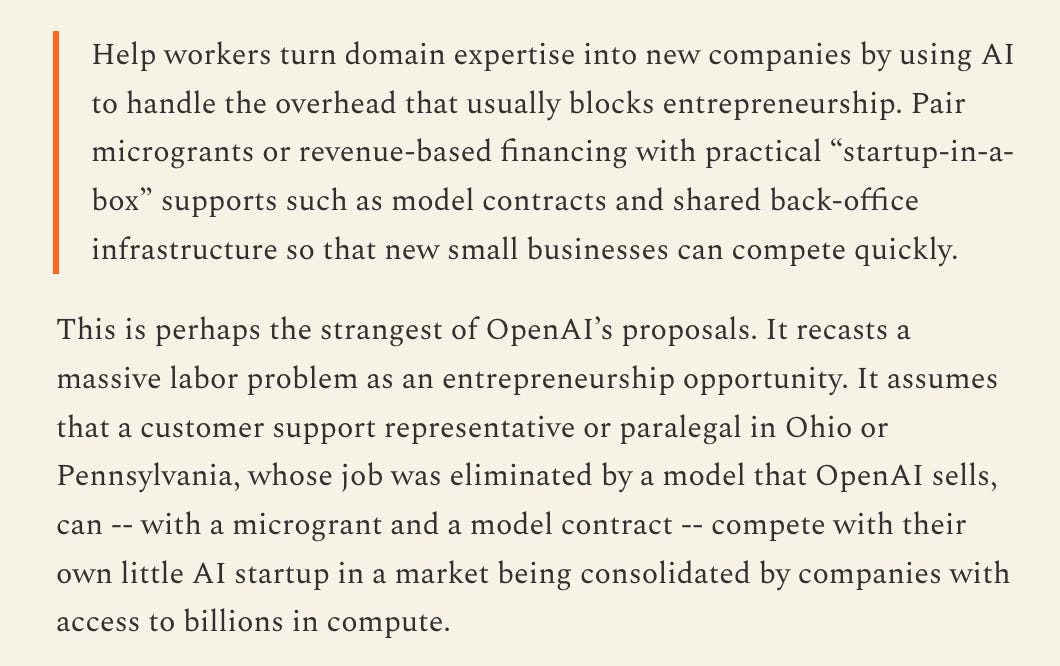
And selling requires buyers with income. If everyone sells, who is left to buy? Millions of people selling millions of products to millions of people is a sentence that sounds like abundance until you ask where the loop closes. Solo entrepreneurship can be genuinely good for people and still be unable to function as an economy, despite the claim that “being a distinct person stopped being a rebellion and became the whole economy.”
I have found two explanations for why the AI companies push this.
The first is the business model. I work in tech and venture capital, which means I spent years professionally evaluating capital efficiency. The large AI companies earn their revenue selling efficiency to enterprises, customers who care about ROI, not human possibility, which has speculative returns and no clear metrics to track. That is the actual product: fewer people doing more. But AI companies sell to consumers too, so they need a story there, and the enterprise pitch was translated accordingly. Efficiency translated to agency. Headcount translated to independence. While helping a company shrink its workforce, let’s also offer the shrunk workforce its new life. The solo unicorn is a consumer translation of an enterprise product, and it is boring because its source material is boring. Most likely, it is a promotion of universal hustle: an acceleration of more of the same, not of human flourishing.
The second explanation is about where desire comes from. The desire tech transmits to us is the only desire it has: be a founder and build a very large company. Tech has flattened all desires into that shape, and it is now selling the average person the flattened version. René Girard, the French theorist, argued that we do not want things directly. We want what we see other people wanting. Desire is imitative, copied from models, and what we want is downstream of who we are watching. Tech doesn’t watch much else beyond big companies, power, and the lone hero. Otherwise it would have projected that too. (Tech dabbles in art and culture, but it doesn’t come across as genuine, evident in how thoroughly the industry was rejected at the Met Gala.)
It did not always work this way. One of Silicon Valley’s genuine achievements has been to fuse compelling visions (curiosity, world-building, freedom, exploration, even transcendence) with capitalist form. Tech watched and embodied other desires (even if it packaged those desires in capitalist form, at least it tried to offer us more than just more of capitalism). The lineage runs back to the 1960s counterculture, which might have been the alternative to capitalism, but it lost out and was absorbed and repackaged within tech instead. The early Bay Area technologists fused libertarian individualism, technological utopianism, and the rejection of traditional institutions. That fusion proved enormously useful. So, beginning in the 1970s, stable lifelong employment and hierarchical corporations gave way to flexibility, individual self-management, and aesthetics. The structure that emerged attracted rebels and misfits who would never have tolerated a Taylorist world, perfectly captured in Apple’s famous 1984 ad aimed at IBM. Those people went on to build some of the largest companies today.
I once read that people want to live in a society, not an economy. How do we carry these massive technological gains toward a more expansive vision of human flourishing? I am trying to think about a replacement vision. I don’t have one yet.
I wonder if an abundance of things sometimes creates a poverty of meaning?
Human beings do seem to live happier(?) and more meaningful lives with achievable goals which require some (but not too much) struggle, connected to basic needs. No-one wants to be down the bottom of Maslow's pyramid, but progress and abundance do seem to have overshot us in the other direction in some ways. The idea of an abundance of hustle and entrepreneurship, highly-leveraged individuals... it doesn't sound very appealing.
I like the idea of better desires! I wonder which cultures have the best desires?