
We can’t understand a person as a sealed-off self from the group, and we can’t understand groups by aggregating all the data on their views and behaviors. The first draws the boundary too tight. The second zooms too far out. Instead, people actually live in a messy middle that we call society or culture.
“I think, therefore I am,” Descartes said. It’s convenient to picture the self as a contained mind that reasons its way to truth. It is the Cartesian theater, assuming that the mind can detach from the world and observe the truth accurately from a distance. We actually don’t have as high agency as we think. The reality is, almost nothing about a person holds up in isolation. Their language, their motives, values, all come from a shared world they were dropped into. As Rumi put it, you are not a drop in the ocean; you are the ocean in a drop.
Social theory of the last few hundred years has been about exploring that. Recently, we have been interpreting how groups think by analyzing large-scale data. They seem universally applicable and factual. But using big data to understand people commits the institutional version of the Cartesian mistake: rising above any context and viewing everyone as objective points from nowhere. True, it captures everyone, but it flattens their experiences. To sort people into rows and averages, you have to strip away the circumstances that made their actions meaningful.
So where does understanding actually come from? It comes from being in the messy middle, from studying people on the savannah rather than in the zoo: in the wild of their real lives, not the cage of a survey. Culture and social context drive our behavior, and make the world intelligible. This is what Heidegger called Being. He argued that Being isn’t a mind analyzing or being analyzed from a distance. Being is the fact that we’re always already inside a world, a situation, a culture, before we ever stop to think. Meaning comes from involvement. We understand a hammer by using it, not by staring at it. This is the ground on which sensemaking builds.
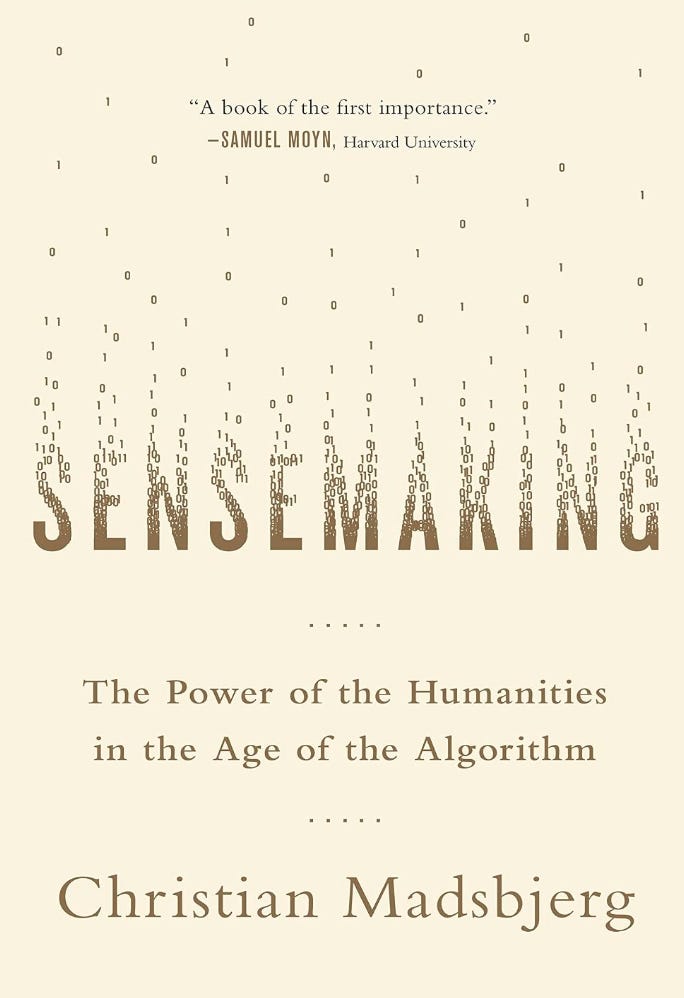
Sensemaking is the title of Christian Madsbjerg’s book. Madsbjerg draws on philosophy, ethnography, and anthropology to develop methods and models for studying politics, business, and markets. The result is a set of studies I genuinely enjoyed, which is rare for me, since I usually avoid business books with many case studies that stretch a single article’s worth of ideas across three hundred pages. But this is not the case here! What makes the difference here is that the cases are grounded in philosophy. For example, Madsbjerg takes Heidegger’s idea (Befindlichkeit) that a mood isn't a private feeling but the way a whole situation shows up to us, coloring what matters and what we reach for, and he uses it to redesign supermarkets around the “evening rush,” rather than what companies typically do, which is to design them around age-and-income segments. He takes Niklas Luhmann’s claim that every profession runs on a binary code, (legal or illegal for lawyers, profit or not for economists), and uses it to defuse a standoff between hospital managers, who saw the world as “at cost” versus “not at cost,” and nurses, who saw it as “good care” versus “bad care.”
The book argues that the humanities are the sharpest tools we have for understanding people, which brings me to the reasons I read it. I have been reevaluating whether I want to stay in investing, so I sent a survey to some of my former colleagues to solicit suggestions. One surprising answer that was the most helpful is “anthropologist.” This got me intrigued and made me want to learn more about the field
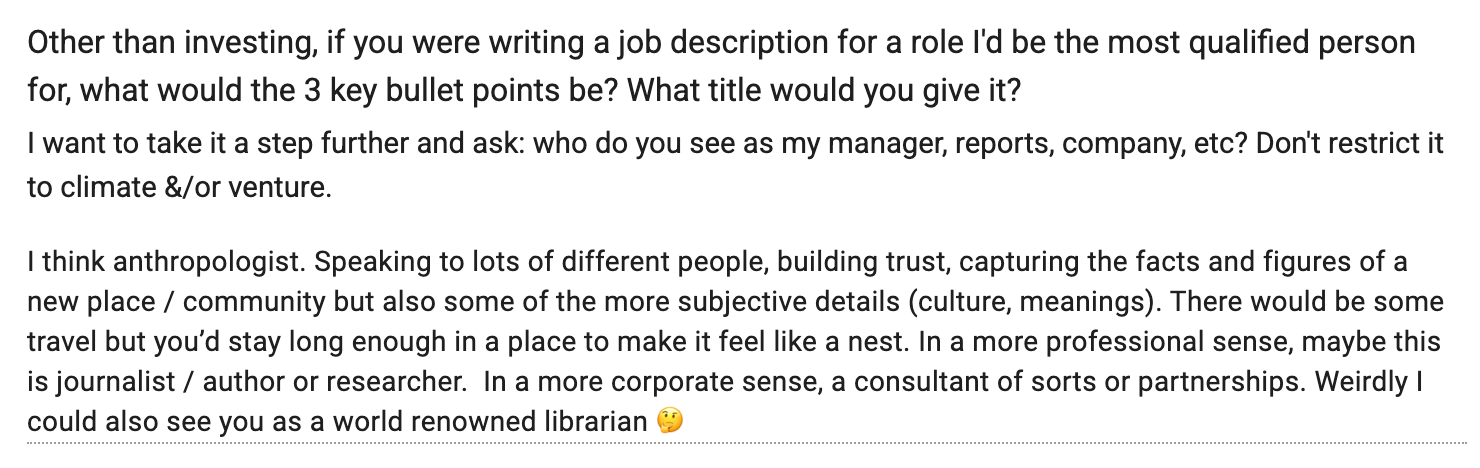
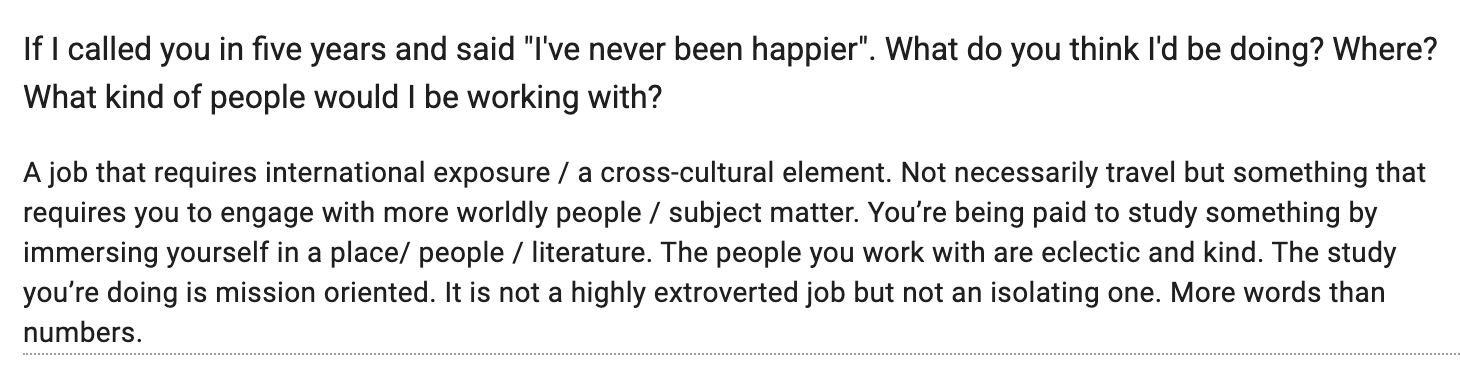
I still don’t know if I can be an anthropologist, but it feels like an important lens to have, given that many of our problems today are increasingly cultural. For now, I want to think like one as I investigate work and what AI is doing to it. Many of our theories about work today are reductive. They treat work as employment, a job and an income, so every solution solves for the job. We will retrain people for new work, the way we did in the industrial age. Or, if they get fired, we will equip them with the tools to become their own employers (a solo company). But work isn't one variable you can isolate and measure. It's the medium people live in. It shapes identity, time, relationships, meaning. I believe that this shake-up in work as a result of AI could be massive and an opportunity to reevaluate many aspects of our society. We shouldn't let this work crisis go to waste.